
Why January 2 Could Trigger the Largest Industrial Reversal in 40 Years
- Stock Market Stocks to buy Stocks to sell
admin
- 0
- 11 minutes read
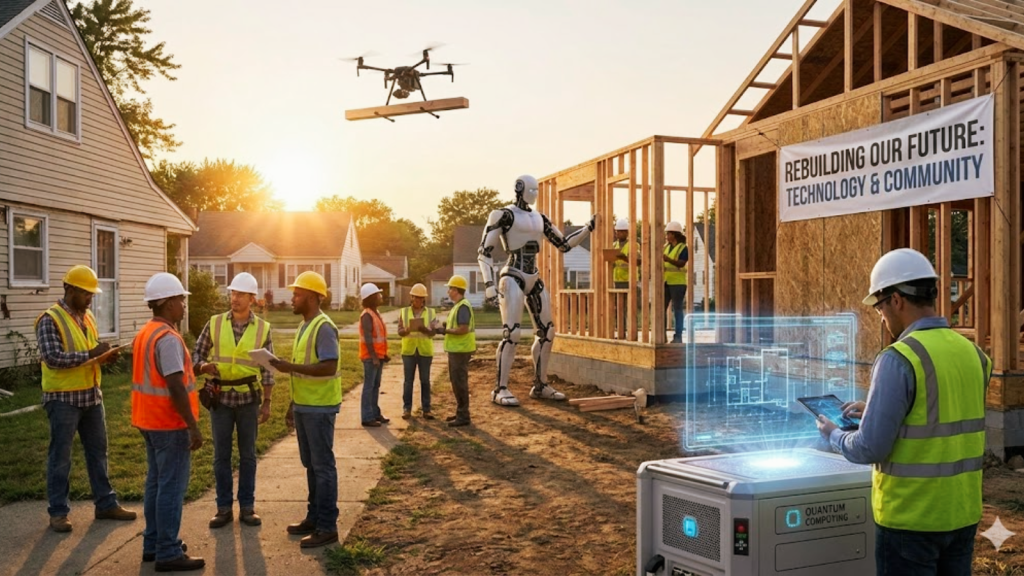
For four decades, American policy had one consistent theme: send it overseas.
Send the factories, the capital, the expertise.
That approach may have led to lower production costs for businesses – and, thus, higher profit margins. But it had a dark side, as well…
China cornered 97% of rare earth processing, dominated batteries and solar, and built supply chains so entrenched that the U.S. can’t manufacture its own defense systems without them.
We became dependent on a geopolitical rival for everything from smartphone components to the materials powering AI.
But that era is ending fast.
More than $11.3 trillion is now committed to rebuilding America’s industrial base – semiconductor fabs, data centers, smart factories, advanced energy infrastructure, all on U.S. soil. Tech giants, manufacturers, even foreign governments are participating in this effort.
January 2 marks a potential inflection point: a coordinated policy shift designed to accelerate this reshoring wave into something transformational.
But this isn’t a cut-and-paste version of past industrial booms.
When Ford revolutionized manufacturing a century ago, it created the American middle class. Today’s revolution is different. A $10 billion facility might employ 5,000 during construction, then run with 500 permanent workers and an army of robots.
The factories are coming back; the jobs aren’t.
But the capital is.
And for investors positioned at the choke points where that capital flows, the next 12 to 18 months could be extraordinary…
That’s the core message behind the American Dream 2.0 Summit. This past Monday, December 8, I joined Louis Navellier and Eric Fry to explain why this next phase of capitalism could be brutal for workers – but absolutely transformational for prepared investors.
Before we get to that, though, I want to:
- Show you why more than $11.3 trillion is flooding into America’s new industrial base – and why January 2 could send this trend vertical.
- Walk you through the four choke points where this money bottlenecks – and the kinds of small companies best positioned to harness it.
- Preview our new American Dream 2.0 Portfolio – and explain why we revealed the tiny Oklahoma company tied to the January 2 catalyst at our Summit.
Take a look…
The $11.3 Trillion Tidal Wave No One’s Ready For
Behind the headlines, a stunning amount of money is already in motion.
Tech giants. Industrial titans. Drugmakers. Automakers. Even foreign governments.
All told, more than $11.3 trillion is earmarked to build out the physical backbone of a new American economy: data centers, semiconductor fabs, smart factories, logistics hubs, steel mills, auto plants, and more – on U.S. soil.
This isn’t a press-release fantasy. It’s happening:
- Big Tech is racing to build out AI supercomputing campuses.
- Manufacturers are bringing production closer to home – not for patriotism, but for security and speed.
- Foreign sovereign wealth funds are quietly pledging trillions to participate in this “Made in America (Again)” reset.
After decades of offshoring factories, capital, and know-how to China – and watching that nation corner markets in rare earths, batteries, and solar – this $11.3 trillion wave is America’s effort to claw back control of critical industries and supply chains.
It’s as much about national security as it is about economics.
The Washington Post recently described the capital pouring in as “the envy of the world.”
At our Summit, Louis, Eric, and I explained why that’s not hyperbole – and why is the day this slow-building trend could go vertical. That’s when a coordinated policy pivot is set to accelerate reshoring, infrastructure, and advanced energy all at once.
But here’s the twist almost no one is talking about…
This isn’t a “jobs boom.”
It’s an automation boom.
Why This Reshoring Boom Belongs to Owners
When Ford built its iconic Highland Park plant a century ago, it created tens of thousands of new middle-class jobs and kicked off a mass-consumption supercycle.
That was old-school industrialization.
Fast-forward to today:
- A $10 billion data center gets built…
- It needs 5,000 workers during construction …
- And then it runs with maybe 500 long-term jobs.
Same story with next-gen factories and distribution hubs.
The headlines brag about “thousands of construction jobs.” But when the ribbon is cut, the “workforce” is a fleet of robots and AI systems.
In other words:
American Dream 1.0 created the U.S. middle class.
American Dream 2.0 will create a new investor class.
That’s why this Summit matters so much. Louis, Eric, and I don’t sugarcoat it. We walk you through why:
- AI is accelerating a historic labor reset…
- Major firms are openly betting they can grow profits without growing headcount…
- And why even conservative voices in finance now warn that waiting on the sidelines could devastate long-term returns.
When you pour $11.3 trillion into rebuilding the real economy, the money doesn’t flow evenly. It bottlenecks in a handful of choke points – key nodes where tiny suppliers become indispensable.
We’ve spent months mapping those bottlenecks. And at the summit, we revealed a new portfolio designed to target four of the most explosive ones (catch the summit replay to learn all about those picks).
That “power portfolio 2026” includes:
- The automation backbone company powering warehouse robots and AI-driven logistics – the systems big retailers are standardizing on as they quietly flip from “humans with barcode guns” to fully automated fulfillment.
- A “Made-in America” mineral play tied to the rare earths and other strategic materials that make advanced robotics, EVs, defense systems, and AI hardware possible.
- The next-generation power source for this buildout – smaller, safer nuclear technologies designed to provide the oceans of cheap, reliable electricity that data centers and factories demand.
- And the “new oil” data infrastructure that collects, moves, and refines the information feeding AI, automation, and smart manufacturing – a quiet tollbooth business sitting upstream from some of the world’s most powerful brands.
We’re not talking about mega-caps you already own in an index fund. These are under-the-radar players sitting at the chokepoints of American Dream 2.0.
The Final Word
At our Summit, we walked through what we see as the official start of this next industrial revolution – a Washington policy pivot that pulls together:
- The $11.3 trillion capital wave into U.S. industry…
- A coordinated push to reduce dependence on Chinese critical materials…
- A fast-tracked buildout of advanced energy…
- And aggressive moves to promote smart factories, humanoid robots, and AI logistics at national scale.
You’ll see why we believe:
- The market could be headed into a 12- to 18-month melt-up before any eventual crash…
- The Nasdaq-100 could double from here in a late-cycle surge…
- And owning the right “choke point” names could dramatically outpace the big indexes.
Most importantly, you’ll get:
- The name and ticker of the tiny company in that small Oklahoma town at the center of the January 2 catalyst – revealed as a free pick at the Summit…
- A deeper dive into our brand-new American Dream 2.0 Portfolio…
- And a candid conversation on everything from interest rates and tariffs to AI, China, energy, and the risk of a future crash.
The last time Louis, Eric, and I put together a portfolio like this was in late 2024. A year later, those picks have returned 32%.
That’s close to triple the Dow‘s return over that stretch and more than double the S&P 500‘s.
The time before that was in late 2023. Those recommendations returned 35% gains and again beat the big indexes by a wide margin.
Now we’re doing it again.
You can watch it happen from the sidelines.
Or you can show up prepared.
If you believe the original American Dream is worth updating – and want a real shot at participating in that upgrade – then don’t wait.
Watch our American Dream 2.0 Summit to find out how to make the most of this financial revolution before it goes offline.


