The Quiet Power Play Wall Street Is Missing in the AI Boom
- Stock Market Stocks to buy Stocks to sell
admin
- 0
- 12 minutes read
Editor’s note: “The Quiet Power Play Wall Street Is Missing in the AI Boom” was previously published in November 2025 with the title, “Before the Battery Boom: The Quiet Opportunity Powering the AI Revolution.” It has since been updated to include the most relevant information available.
In the summer of 1896, the lights went out in Manhattan.
Not because the city lacked capital or brilliant engineers. Rather, the city had grown faster than its infrastructure could support.
The electric dynamos that powered the new age of industry simply couldn’t keep up with demand. Factories stalled. Streetcars froze in place. Progress, it turned out, had a bottleneck.
History rarely remembers the bottleneck. It remembers the winners who solved it.
That’s the uncomfortable question investors face today.
Everyone’s fixated on AI chips. On trillion-dollar valuations. On whether Nvidia (NVDA) can keep defying gravity. But while the crowd debates multiples and margins, something more basic — and far more dangerous — is quietly breaking beneath the surface.
AI is running ahead of the grid.
Tesla (TSLA) all but confirmed what we’ve suspected for months: the next great computing bottleneck isn’t chips – it’s power.
The company recently launched a new marketing push for its Megapack batteries, aimed directly at AI data centers battling wild, unpredictable power swings. Tesla claims its systems can absorb up to 90% of AI-induced load volatility, stabilizing sites where energy demand can spike or crash by several megawatts in seconds.
It’s a reminder that as AI training stresses the grid to its limits, batteries are quietly becoming as essential to AI infrastructure as GPUs themselves…
And we’re already seeing that shift begin to play out in real time.
Canary Media recently reported that – instead of waiting on infrastructure upgrades, new gas turbines, or lobbying utility companies for more power – Aligned Data Centers is purchasing a new 31-megawatt/62-megawatt-hour battery to power its new facility in the Pacific Northwest. According to the companies involved, this deal will get Aligned’s data center running ”years earlier than would be possible with traditional utility upgrades.”
These moves tell us everything we need to know about where we are in the AI infrastructure cycle – and where the next big investment opportunities are hiding.
AI data centers are running ahead of the grid; and batteries are how they’ll bridge the gap.
Instead of waiting on utilities or new gas turbines, hyperscalers are turning to utility-scale batteries to unlock capacity, stabilize voltage, and keep training clusters humming. It’s the clearest signal yet that batteries are becoming core AI infrastructure.
It’s a brilliant hack – and it’s likely to become standard practice for every hyperscaler racing to deploy AI capacity.
And in today’s issue, I’ll show you why batteries are rapidly becoming core AI infrastructure — and which companies are quietly positioning themselves to ride what could become the next trillion-dollar investment theme.
The AI Battery Boom Is Here
Data centers are quickly becoming the largest power consumers on the planet.
That’s why the companies solving AI’s energy bottleneck could see growth that rivals – or even surpasses – the chip boom itself.
Just as Nvidia (NVDA) became the bottleneck supplier for AI compute, the companies capable of delivering utility-grade batteries are positioning themselves as bottleneck suppliers for AI power.
Think about it this way. Every AI data center needs:
- Graphics Processing Units (GPUs) to run their models
- Reliable power to keep the lights on and the regulators happy
It’s the same dynamic; and it creates the same kind of explosive opportunity.
We see three very interesting ways to play it.
Eos Energy: The Zinc Battery Play for AI Data Centers
Most current batteries are lithium-ion. But lithium-ion has limits: it’s expensive, it degrades quickly when cycled hard, and it’s not optimized for multi-hour storage.
Enter Eos Energy (EOSE).
Eos builds zinc-based batteries that are specifically designed for longer applications, between four and 10 hours. That’s the sweet spot for data centers looking to buffer grid demand and secure overnight uptime. And unlike lithium-ion, zinc doesn’t require nickel, cobalt, or lithium – minerals increasingly caught up in geopolitical snares.
The company has quietly amassed a multi-billion-dollar project pipeline. And if other data centers go the way of Aligned, the AI Boom could pour gasoline on that fire.
Think of Eos as the ‘non-lithium bet’ on AI storage. If hyperscalers start diversifying battery chemistry to reduce risk, Eos is perfectly positioned.
Fluence Energy: The Leading AI Data Center Battery Stock
Now, where Eos is the scrappy upstart, Fluence (FLNC) is the established pure-play leader in grid-scale batteries.
A joint venture between AES (AES) and Siemens, Fluence has already deployed more than 7 gigawatts of storage worldwide. The company offers both hardware and sophisticated software to manage storage systems, making it a one-stop shop for data centers and utilities.
If you’re a hyperscaler that needs 200 MW of storage integrated into your new AI campus, Fluence is the first number you call.
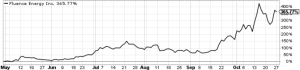
Investors have started to notice. Shares have surged nearly 370% since spring.
But even still, the runway here is massive. Fluence could be to AI batteries what Nvidia was to AI chips: the name brand everyone trusts.
Tesla’s Megapack: The Hidden AI Infrastructure Powerhouse
Everyone knows Tesla for its cars – and now its humanoid robots. But the company has quietly become one of the world’s largest battery companies.
Tesla’s Megapack business has locked in multi-year, multi-billion-dollar contracts, most notably:
- a 15.3 GWh supply agreement with Intersect Power valued at over $3 billion through 2030
- and a June 2025 order from Clearway Energy for 490 MW/1,356 MWh that industry reports peg at roughly $450 million
With Tesla cranking out record volumes – 12.5 GWh of Megapacks in Q3 2025 alone and over 31 GWh in 2024 – demand is so strong that new orders are getting pushed well into future calendar years. In other words, Tesla’s battery business isn’t just busy… it’s booked solid for years, as utilities and power producers race to lock in capacity before the grid revolution leaves them behind.
Recent moves suggest Tesla sees where the market is headed. The company is clearly aligning its Megapack business with the surging power demands of AI, positioning itself as the go-to provider for hyperscalers that need flexible, grid-stabilizing storage fast.
That alignment gives Tesla a near-unmatched edge. It already has the factories, supply chains, and track record to deliver multi-megawatt systems at industrial speed. For AI developers facing power constraints, that combination of scale and reliability makes Tesla the obvious partner.
This makes it not just an EV stock but a stealth AI infrastructure play hiding in plain sight.
Investing in the Data Center Power Revolution
Aligned’s battery tactic isn’t a one-off curiosity. It’s a preview of the next wave of the AI trade.
First was GPUs. Then energy. Now? Storage.
Every AI data center built over the next decade will almost certainly come with a giant battery project attached. That’s tens – maybe hundreds – of billions in new demand for grid-scale batteries…
Which means the companies building those batteries could ride the same exponential curve Nvidia has over the last five years.
If you believe AI is the future, you need to believe batteries are the enabler. And you need exposure to the stocks that make it happen.
Bottom line: AI isn’t just a compute story anymore. It’s a power story. And in that power story, batteries are the unsung hero.
Today’s headline about data centers building giant batteries to get online faster is tomorrow’s trillion-dollar investment theme.
But zoom out, and this battery shift is just one piece of a much bigger pattern forming beneath the AI boom.
Over the past few months, the U.S. government has quietly taken equity stakes in a handful of small, strategically critical companies — moves that blindsided Wall Street and sent those stocks soaring shortly afterward. In each case, the signals were visible before the headlines hit… if you knew where to look.
AI has entered a new phase — one where compute, energy, storage, and national strategy are converging. The White House isn’t reacting anymore. It’s positioning. Securing supply chains. Accelerating infrastructure. Picking choke points it can’t afford to lose.
Data center power is one of those choke points.
Grid-scale batteries. Nuclear-adjacent energy. Advanced infrastructure plays that sit at the intersection of AI growth and national priority.
That’s why I recently went to Silicon Valley to unveil what I call the Hyperscale Revolution — a new phase of the AI wealth cycle where capital, policy, and exponential technology start reinforcing each other. Historically, this is the part of the cycle that creates fortunes fast… but only for those positioned early.
I believe one small, overlooked company — operating in an unexpected corner of the energy market — fits this pattern almost perfectly.
I’ve laid out the full evidence, the pattern, and exactly how I’m positioning in my latest briefing.
If you want to see what I’m seeing — and decide for yourself before the next headline hits — I strongly suggest you watch it now.